
Aluminium Sand Casting
Aluminium sand casting, from 0.1 kg to 110 kg.
Metline Casting is an aluminium sand casting manufacturer in Rajkot, Gujarat. We cast to your drawing or sample, then heat treat, impregnate, finish and machine the part in-house — so one supplier carries it from molten metal to inspected component.
The Process
What is aluminium sand casting?
Aluminium sand casting is a metal forming process in which molten aluminium is poured into a mould formed from bonded sand. The sand is packed around a pattern to create the outer shape, cores are set to form any internal cavities, and the mould halves are closed. Aluminium is melted, degassed and poured in under gravity. Once the metal has solidified, the sand mould is broken away — it is expendable, used once — and the raw casting moves on to fettling, heat treatment and machining.
That expendable mould is the whole economic argument for the process. Because the mould is sand rather than hardened steel, tooling costs a fraction of a die casting die, part size is limited by the moulding box rather than a machine’s clamping force, and a design revision means reworking a pattern instead of recutting a die. It is why sand casting remains the default route for prototypes, spare parts, large components and production volumes up to a few thousand pieces a year.
Aluminium and aluminum are the same metal — “aluminium” is the IUPAC and British spelling used across India, the UK and Europe, and “aluminum” is the American spelling. Standards you may see on a drawing use both: BS 1490 and EN 1706 write aluminium, while ASTM and the Aluminum Association write aluminum. Whichever spelling your drawing uses, the castings we pour are the same, and we quote from either.
Send Us Your Part
A drawing, a 3D model, or the physical component — we will review castability and come back with a quote, usually the same working day.
How We Cast
The eight-stage aluminium sand casting process.
Every casting we pour moves through the same controlled sequence. Nothing in this list is subcontracted — all eight stages run inside our Ribda facility.
Core Making
High quality core making for accurate, repeatable casting geometry.
Melting & Pouring
Aluminium melted under controlled conditions and poured with precision.
Sand Casting
High quality sand casting engineered for strong, reliable components.
Heat Treatment
Thermal treatment improves strength, durability and performance.
Vacuum Impregnation
Porosity elimination for leak-proof, pressure-tight castings.
Sandblasting
Clean, uniform surface preparation ahead of finishing.
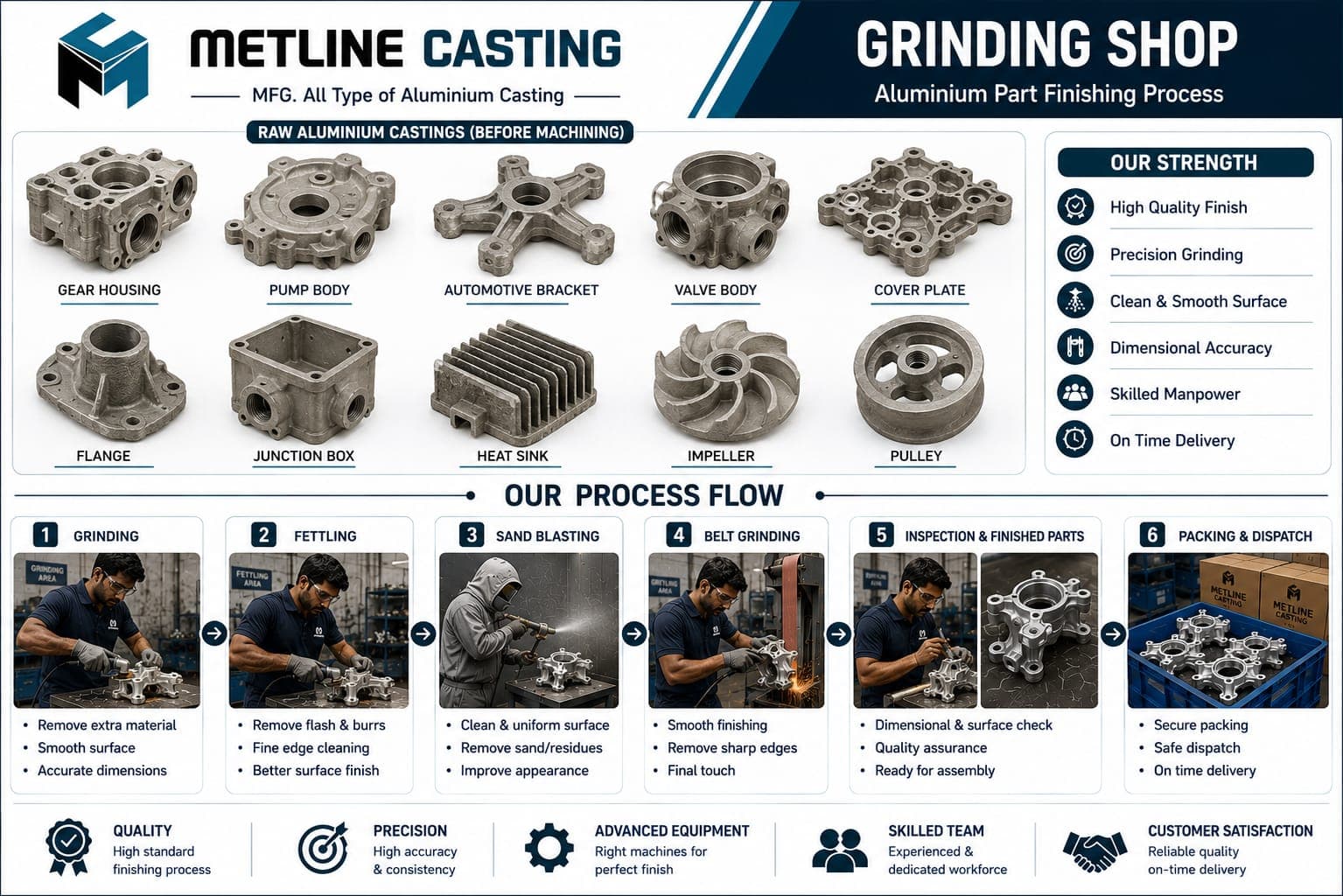
Grinding & Finishing
Precision grinding and fettling that ensure accurate dimensions and a flawless finish.
Machining
Precision machining tailored to meet complex specifications and stringent industry standards.
Capabilities
Aluminium casting capacity and capabilities.
The numbers a buyer needs before sending a drawing. Every figure below is drawn from our own machinery schedule — not an estimate.
| Capability | Specification | Detail |
|---|---|---|
| Casting process | Aluminium sand casting | CO₂ and no-bake core routes, gravity poured |
| Piece weight | 0.1 – 110 kg | Single-piece weight range handled in-house |
| Annual capacity | 150 MT / annum | Casting production capacity |
| Melting capacity | 1 MT / day | 150 kg crucible furnace |
| Core capacity | Up to 25 kg | Fully automatic cold-core machine |
| Blasting throughput | 110 kg / hour | Dedicated sand blasting plant |
| Machining | 3-axis & 4-axis VMC | X-800 / Y-550 / Z-550 mm travel, plus lathe and drilling |
| Alloys | LM2, LM6, LM25 | BS 1490 grades, or cast to the grade on your drawing |
Why Sand Casting
When aluminium sand casting is the right process.
Sand casting is not always the answer — at very high volumes with thin walls, die casting wins on piece price. Here is where sand casting is clearly the better route.
No tooling bill to absorb
Sand moulds are made from patterns, not hardened steel dies. That puts the entry cost an order of magnitude below high pressure die casting, which is why sand casting wins on prototypes, spares and anything under a few thousand pieces a year.
Large and heavy parts are routine
We pour single pieces from 0.1 kg up to 110 kg. Die casting struggles past a certain size and weight; a sand mould simply gets bigger.
Complex internal passages
Bonded sand cores form internal cavities — water jackets, oil galleries, hydraulic passages — then break out after solidification. Cores are how a casting gets geometry no machining operation could reach.
Design changes cost days, not months
Revising a pattern is quick and cheap next to recutting a die. Sand casting suits parts that are still evolving.
Full heat treatment response
Sand castings can be taken to T6. LM25 climbs from a 130 N/mm² as-cast baseline to a 230 N/mm² minimum in sand-cast T6 condition — a route that isn't open to most pressure die castings.
Any aluminium alloy, any batch size
The same moulding line runs LM6 for corrosion resistance, LM25 for structural strength, or whichever grade your drawing specifies — with no tooling change between them.
Alloy Selection
Which aluminium alloy suits your sand casting?
LM6 and LM25 are both rated Excellent for sand casting under BS 1490 Table 8. Which one fits depends on whether the part needs corrosion resistance or structural strength.
Applications
Aluminium sand cast parts we produce.
Nine categories, all cast to customer drawing or sample.
Frequently Asked Questions
Aluminium sand casting — frequently asked questions.
The questions buyers ask most before sending us a drawing.
How does the aluminium sand casting process work, step by step?
Metline Casting runs eight controlled stages: (1) core making, where bonded sand cores form the casting's internal cavities; (2) melting and pouring of the aluminium under controlled temperature; (3) sand casting itself, where the metal fills the mould and solidifies; (4) heat treatment to develop strength and dimensional stability; (5) vacuum impregnation to seal residual porosity in pressure-tight parts; (6) sand blasting to clean the surface; (7) grinding and fettling to remove flash and bring dimensions to drawing; and (8) precision VMC or CNC machining of critical features.
What is the difference between sand casting and die casting for aluminium?
Sand casting uses an expendable mould made from bonded sand, so tooling is inexpensive, parts can be large — we pour up to 110 kg — and the casting responds fully to T6 heat treatment. Die casting forces metal into a reusable steel die under pressure: the per-piece cost is lower at very high volume and thin walls are easier, but tooling costs far more, part size is limited, and entrapped gas usually rules out T6. Sand casting is the right choice for prototypes, spares, large parts and volumes up to a few thousand a year.
What tolerances can aluminium sand castings hold?
As-cast tolerance depends on the part's size, wall section and the number of cores involved, so we confirm achievable tolerance against your specific drawing rather than quoting a blanket figure. Critical features — bores, sealing faces, mounting datums and threads — are held to drawing tolerance by machining them on our 3-axis and 4-axis VMC line after casting, and every dimension is verified against drawing before packing.
Which aluminium alloy is best for sand casting?
LM6 (Al-Si12) and LM25 (Al-Si7Mg0.5) are both rated 4 — Excellent — for sand casting under BS 1490 Table 8. Choose LM6 when corrosion resistance and castability of thin, intricate sections matter most, and LM25 when the part is structural and needs T6 strength, which takes it to a 230 N/mm² minimum tensile in sand-cast condition. LM2 is fundamentally a die casting alloy and is rated only 3n for sand casting.
Can sand cast aluminium parts be made pressure tight?
Yes. Aluminium castings can retain fine porosity that leaks under pressure. We run vacuum impregnation in-house, drawing sealant into that porosity so the part holds pressure without weeping — the standard route for hydraulic manifolds, pump bodies, valve housings and fire fighting fittings.
Do you machine the castings you pour?
Yes. We machine in-house on two VMC machines with X-800 mm, Y-550 mm and Z-550 mm travel and a rotary table, running both 3-axis and 4-axis work, backed by conventional lathe and drilling machines. Buying the casting and the machining from one supplier removes a handoff, and it means dimensional responsibility sits in one place.
What is the minimum order quantity for aluminium sand casting?
There is no fixed minimum — because sand moulds are made from patterns rather than steel dies, small batches, prototypes and one-off spares are all viable. Send the drawing and the quantity you need and we will quote against it.
Do you make the pattern, or does the customer supply it?
Either works. If you already hold a pattern we can cast from it directly. If you don't, send the drawing or sample and we will handle pattern requirements as part of the quotation.
Explore Next
Where to go next.
Start a Program
Send your drawing or sample — we’ll cast it right.
From core making to finished, inspected components, Metline Casting runs the full aluminium casting process in-house.